Albion Elementary Reading Scores Climb Districtwide, But the Cohort Hit Hardest by the Pandemic Still Lags
At its March 5, 2024 meeting, the Albion Board of Education heard a mid-year update showing districtwide elementary reading proficiency has grown since a 2021 pandemic low, though the one cohort hit hardest by COVID posted a slight decline even as its neediest students shrank in number. The board also adopted eleven revised policies as a block and approved a routine slate of budget, personnel and program items.
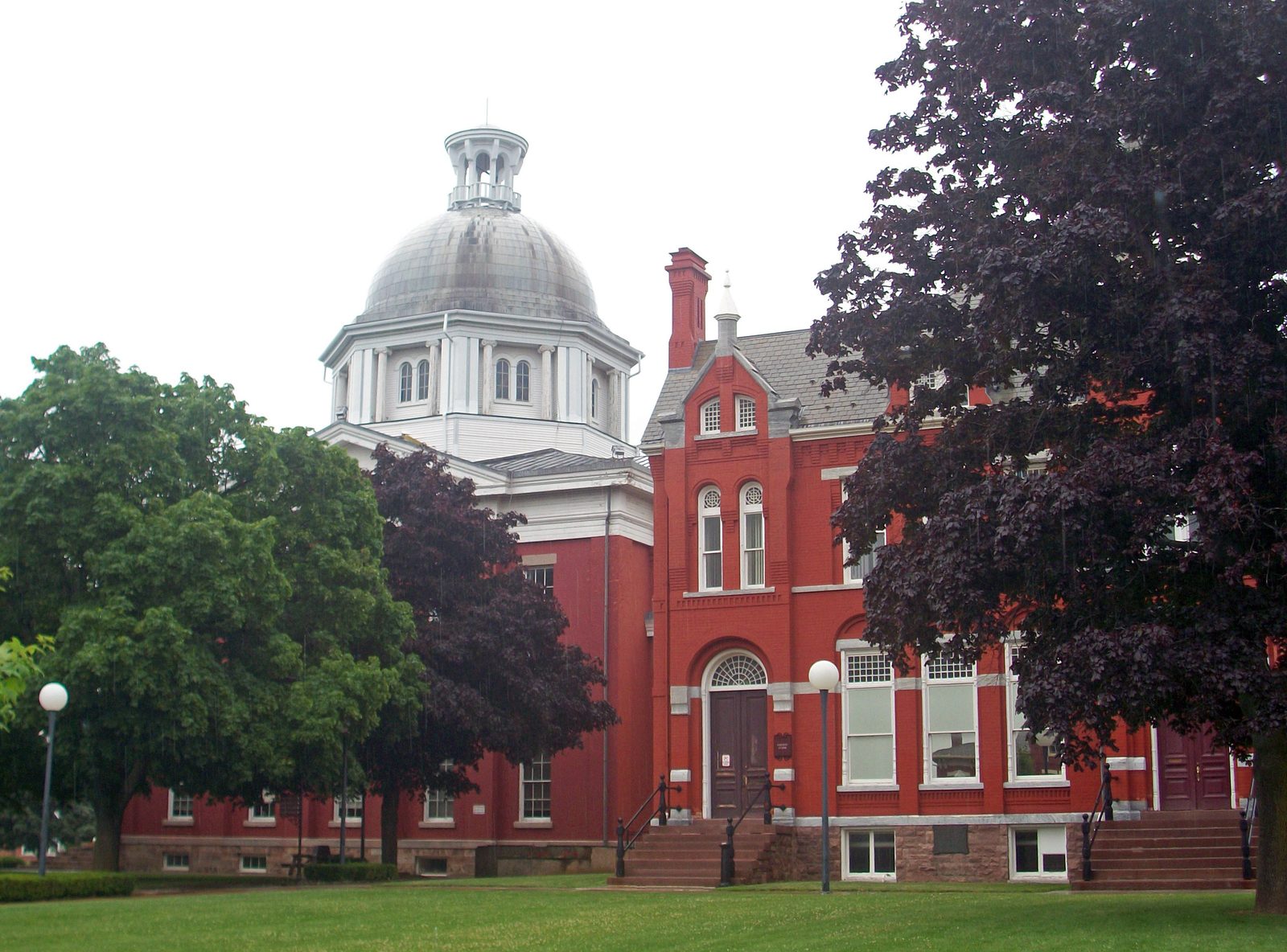
Orleans County Courthouse, Albion, NY — photo:
Daniel Case
(BY-SA 3.0)
▶Key Actions & Decisions
●• Angela Conway, Elementary School Principal, presented mid-year STAR reading data: districtwide, students reading at or above grade level rose from 47% at the start of 2023-2024 to 57% at midyear; she called the district not yet satisfied but pleased with the progress.
●• Conway projected that if the trend holds, 60% to 62% of K-5 students could read at or above grade level by the end of the 2024 school year, and 70% or higher by 2028.
●• Rebecca Manfreda, Assistant Superintendent for Instruction, reported a March 11 Staff Development Day will continue districtwide curriculum-mapping and scope-and-sequence work, now in year two of a three-year plan, with Orleans Niagara BOCES and Genesee Valley BOCES assisting.
●• School Resource Officer Deputy Matthew Prawel told the board that High School parking-pass sales rose from 31 in 2022-2023 to 79 in 2023-2024, with proceeds going to the Student Council; he also described a revamp of the district's Threat Assessment Policy and Form and a reconfiguration of campus cameras.
●• Board Policy, Process and Protocol Committee chairperson Mrs. Weller reported the committee's first read of eleven revised policies (3420, 5630, 6121, 6130, 6550, 7350, 7420, 7512, 7670, 8240, 8450); the board approved waiving second reading and adopted all eleven as a block.
●• BOARD APPROVED a $6,000 budget transfer for audio-visual equipment; a separate $1,200 transfer for fuel-tank electric-line installation was presented for information only.
●• Finance and Audit Committee chairperson Mr. Kast reported the fuel-price comparison favors Kurk over the district's Fuel Farm and that one of two originally scheduled March budget meetings was consolidated to March 26.
●• BOARD APPROVED a change to the budget vote location and final approval of the 2024 High School Band Trip to Toronto, May 10-12.
●• Personnel actions: resignations of Louis DiRienzo (substitute cleaner, effective 02/16/24) and Rachel Patten (clerk at the district office, effective 02/06/24); child-rearing leave for Rachael Dixson (first grade special education teacher), 11/28/23-03/05/24; new appointment of Eddie English as a monitor at the elementary school.
●• BOARD APPROVED the Middle School Enrichment Class's donation of chalk, chalkboard erasers, old soccer uniforms and soccer balls, to be delivered to children in Malawi by Mr. Tim Archer, along with donations of a flute and bottled water to the district.
Angela Conway, Elementary School Principal, brought the Albion Board of Education back on March 5 to a slide she had first shown the previous month: districtwide, the share of Kindergarten-through-fifth-grade students reading at or above grade level had climbed from 47% at the start of the 2023-2024 school year to 57% at midyear, according to the minutes. She said she was not satisfied with 57%, but was happy with the progress that had been made.
The number matters against where the district started. In the fall of 2021, only 26% of K-5 students were reading at or above grade level, and more students needed urgent intervention than were reading proficiently, the minutes record. That school year ended at 52%. The two years since have each begun with a dip — a summer slide from two months away from instruction — before climbing back through the year.
This year's cohort-by-cohort breakdown showed most grades continuing that climb: second grade rose from 37% in the fall to 54% in the winter, third grade from 49% to 62%, and fifth grade from 47% to 53%. Fourth grade moved the other way, slipping slightly from 56% in the fall to 53% in the winter — the only grade tracked that declined. According to the minutes, fourth grade was the cohort hit hardest by the pandemic, with almost half its students needing urgent intervention in the fall of 2021. That same group's share needing urgent intervention has continued to shrink, from 23% in the fall of 2023 to 16% this winter, even as its overall grade-level reading percentage slipped.
Conway walked the board through what the district has changed to produce the districtwide gains. The Response to Intervention process was revamped to assign an intervention teacher to every grade level. A new program called WIN — What I Need — gives all students 30 to 40 minutes of targeted support daily. A Student Support Team now monitors students needing the most intensive, Tier 3 services, and the special-education referral process has been streamlined. New K-5 English Language Arts curricula, including Amplify CKLA, Really Great Reading and Heggerty, have been adopted, alongside a new assessment calendar built around STAR, a Really Great Reading grouping matrix and DIBELS testing for new entrants. One slide posed the question "What have we been doing differently?" before running through that list.
Conway's list of next steps — curriculum maps and scope-and-sequence documents, standards-based report cards, and a shift toward skills vs. knowledge and the science of reading — connected directly to a report delivered later in the same meeting. Rebecca Manfreda, Assistant Superintendent for Instruction, told the board that faculty will spend a March 11 Staff Development Day continuing exactly that work: the district is in year two of a three-year plan to bring every curriculum area and course into the same digital format for scope-and-sequence and curriculum-mapping documents, with Orleans Niagara BOCES and Genesee Valley BOCES assisting. Manfreda described the documents as meant to travel with the district — usable by administrators reviewing teachers' work, by teachers changing grade levels or courses, and by long-term substitutes and new hires stepping into a classroom mid-year.
Conway told the board that if the current trend holds, 60% to 62% of K-5 students could be reading at or above grade level by the end of the 2024 school year, with continued progress potentially reaching 70% or higher by 2028. She cautioned that the pace of change is affected by students moving in and out of the district, students with disabilities, English Language Learners, and instruction itself — factors the board will be able to measure again against the next data update.
The rest of the March 5 agenda moved through routine district business. The board adopted eleven revised policies as a block after Board Policy, Process and Protocol Committee chairperson Mrs. Weller reported the committee's first read, waiving a second reading under the terms of the district's own policy on policy adoption. The Finance and Audit Committee, whose chairperson Mr. Kast said continues to work through building-level budgets, reported that a fuel-price comparison favors the district's use of Kurk, and that one of two March budget meetings had been consolidated to March 26 to allow more complete information to be ready for review. The board also approved a $6,000 transfer for audio-visual equipment, a change to the budget vote location, final approval of the High School band's May trip to Toronto, and a slate of personnel resignations, appointments and leave requests.
Share
Coverage of the Board of Education meeting on 2024-03-05,
Village of Albion, NY.
View original document ↗
This article was drafted by AI (claude-sonnet-agent) from the official meeting transcript and reviewed by a human editor.
Quotes link to source video timestamps for verification.
Read our editorial policy.
Community Discussion
0 comments
Be the first to comment on this story.
🔍Ask Albion
Have a question about this story? Search across meeting transcripts, village history, and municipal code.
Related Board of Education Meetings
Albion Principals' Mid-Year Report Finds Reading Gains That Don't Always Hold
●• Board approved Business Items A-F (Jan. 8, 2024 meeting minutes, November and December 2023 Treasurer's Reports, December 2023 Extra Classroom Activity Fund Report, CSE and CPSE recommendations, and Committee on Special Education referral information, plus a $10,000 budget transfer for elementary science field trips) and Items H-I (building-use and fundraiser requests); a separate $4,500 unemployment-insurance-premium transfer was presented for information only.
●• Kast, Board Member, reported for the Finance and Audit Committee that the district's NYCLASS investment returns brought in a $1.6 million return, aided by currently high interest rates that Rick Recckio cautioned would not necessarily continue; lower anticipated state aid will require a conservative approach to the 2024-2025 budget, now in development.
●• Board approved the 2022-2023 Single Audit Report (Mengel Metzger Barr & Co./Raymond F. Wager, CPA) and the 2023-2024 Internal Control Risk Assessment and Corrective Action Plan (EFPR Group).
●• Board approved the 2024-2025 school year calendar, a contract with Hilton Central School District, an amended Elizabeth J. Rawlings "Mrs. Wizard" Memorial Scholarship, and a list of surplus items for auction.
●• Board approved personnel actions including five staff resignations effective in January and February, the appointment of Margaret Stewart as Community School Public Relations Coordinator at a $60,000 salary (prorated $55,154), and other appointments, substitutes and extra-curricular coaching assignments.
●• Wadhams, Board President, was nominated and approved for another term on the Orleans Niagara BOCES board; he told the board Albion was omitted from the printed program at a recent Niagara Orleans School Boards Association breakfast despite fielding the largest attendance of any Orleans County district, and said the board may weigh whether to remain in NOSBA or join the Erie County School Boards Association.
●• Bennett, Board Member, urged the board to be more transparent with the community ahead of its vote in May.
●• Dates approved: Finance and Audit Committee meetings Feb. 13, March 12 and March 26; regular board meetings March 5 and April 9; and the BOCES budget vote and election April 23.
Albion School Board Locks In May 21 Ballot: Zero-Percent Tax Levy, $15 Million Reserve Fund, New Buses
●• Board adopted (8-0, Christopher Kinter absent) a resolution declaring a $100,000 bus-garage upgrade project (replacement of doors, frames, hardware, ceilings and lighting) a Type II action under SEQRA, exempt from environmental review, to be funded through a Transfer to Capital Fund line in the 2024-2025 budget.
●• Board adopted (8-0, Kinter absent) the Annual School District Meeting Resolution setting the May 21, 2024 vote at Hoag Library (noon-8 p.m.) on the 2024-2025 budget and three other propositions: $650,000 for bus purchases from the Bus Purchase Reserve Fund, $664,510 for the Hoag Library, and a new Capital Improvements Reserve Fund capped at $15,000,000 over a term of up to 10 years. Two Board seats (five-year terms) are also on the ballot; candidate petitions are due by 5 p.m. April 22, 2024.
●• Board adopted (8-0, Kinter absent) a resolution designating election personnel, naming Wayne Wadhams permanent chairperson, Cindy M. Ishmael chief election inspector, and Richard Recckio II assistant clerk; inspectors without a contracted rate are paid $16 per hour.
●• Finance and Audit Committee Chairperson John Kast reported the committee met March 26 to finalize the proposed budget, which goes out at zero percent on the tax levy; the minutes record him saying the process "has been challenging because theoretically, we're not sure of the state's budget."
●• During public forum, bus driver Heather Allchin asked the Board to fund an aide for every large bus route, citing runs of 20-45 students per bus; the minutes record no Board response or vote on the request.
●• Personnel actions: retirements of sixth-grade teacher Mary Jane Klips and cleaner Ricky O'Kussick; resignations of substitute cleaners Charles Hannigan and RoseMarie Matias; new hires Joseph King (custodial worker, $32,760) and Angela Boyce (district office clerk, $38,000).
●• Athletic Director Mariah LaSpina was presented a certificate for the 2024 NYSAAA Liam Frawley Emerging Athletic Administrator Award; Middle School enrichment students presented a repainted fire-station mural and a 3D-printed Hot Wheels track engineered to descend 60 feet from the auditorium balcony to the stage.
●• High School Principal Jennifer Ashbery presented the state's Blue Ribbon Commission on Graduation Measures, covering new multiple pathways (Arts, CTE, CDOS, Civics, Humanities, STEM, World Languages), the Seal of Civic Readiness, Seal of Biliteracy, and the 4+1 Arts pathway; Albion's 22.5 graduation credits (statewide requirement is 22) include a half credit for community service, and the district will return next year to requiring a full 30 hours of service for that credit
●• Board President Wayne Wadhams closed the meeting by saying he has "real concern" about how the Blue Ribbon Commission changes are being communicated, recounting an account from a BOCES meeting of an NCCC student who received a high school diploma but was later required to take, and pay for, additional English and math coursework
●• Budget Transfer Requests: $87,117.53 additional transfer for BOCES adjustments — BOARD APPROVED; a $900.00 Middle School 8th grade field trip transfer was presented for information only
●• Finance and Audit Committee (Mr. Kast) reported the enacted state budget restores save-harmless Foundation Aid cuts, sets Albion's Foundation Aid increase at 2.25%, and allocates $2 million to study the Foundation Aid formula, with recommendations due by December 2024; the district's proposed 2024-2025 budget aligns closely with the state allowance
●• Health & Safety Committee (Mr. Schmitt) reported an unplanned high school evacuation caused by dust in a sensor, with students moved to the elementary school during rain without incident; drywall dust from the ongoing construction project was also raised as a concern
●• Personnel: BOARD APPROVED resignations of Rebekah Thompson, Michael Fahy, and Peter Kemblowski; tenure was granted to Amanda Kast, Cayla Hutteman, Amber Marvin, and Stephanie Hack; two new 2.0 FTE Teacher Aide positions were created
●• Superintendent Edwards reported Orleans County has no preschool special-education program since Rainbow Preschool closed, leaving some eligible children without services; the district is starting an "8+1+2" program in response
●• Donations of $500 to the Albion High School Band and $1,000 to the district were BOARD APPROVED
●• Upcoming dates: Public Hearing May 14 at the HS LGI; Budget Vote May 21, Noon-8:00 pm, at Hoag Library; Graduation set for June 28 on the football field, with a rain-date contingency
Literacy Scores Surge, but Algebra Remains a Challenge: Albion Board Reviews Year-End Academic Data
●Approved Personnel Changes: Accepted the resignation of High School Assistant Principal Paul Gilbert, effective June 30.
●New Hires: Appointed Laura Maier as Elementary School Registered Professional Nurse ($50,000 salary + $1,000 stipend) and Thomas O’Donnell as Middle School Counselor.
●Literacy Data: Elementary School Principal Angela Conway reported a 13% increase in K-5 students reading at grade level (rising from 47% to 60%).
●Safety Upgrades: The Health & Safety Committee reported the installation of exterior signage with door numbers to assist first responders on the single campus.
●Policy Updates: Approved the "Guidelines for Board of Education Members and Administrators" and the "ACS New Board Member Orientation Manual."
●Athletic Recognition: Celebrated the Boys' Track & Field team for their 5th consecutive Niagara Orleans League Championship and the "School of Excellence" status.
Community Discussion
0 commentsBe the first to comment on this story.